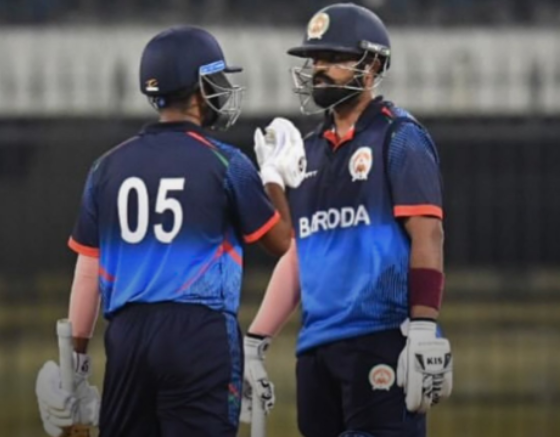
The contest between the Baroda Cricket Team and the Sikkim Cricket Team brings together experience and emerging talent in Indian domestic cricket, where every match scorecard reflects discipline, structured gameplay, and moments of individual brilliance, and these encounters often highlight how established teams maintain control while newer sides look to challenge with determination and smart execution across all phases of the game.
Match Overview & Result Summary
Teams
Date
Venue
Toss
Result
Margin
Player of the Match
Baroda vs Sikkim
December 05, 2024
Emerald High School Ground, Indore
Baroda elected to bat first
Baroda won
263 runs
Bhanu Pania (134* off 51 balls)
Team Innings Score Summary
Team
Innings
Score
Overs
Wickets
Run Rate
Extras
Baroda
1st
349/5
20.0
5
17.45
5 (nb 3, w 2)
Sikkim
2nd
86/7
20.0
7
4.30
6 (b 4, lb 1, w 1)
Run Chase Difficulty Index
Metric
Required Value
Actual Value
Difficulty Index (1-10)
Key Insight
Target Score
350
86
10
Highest T20 total ever set; record-breaking chase pressure
Required Run Rate
17.50
4.30
10
Far beyond typical T20 chases (average ~8-9 RR)
Run Rate Deficit
13.20
–
10
Massive gap; impossible to bridge in 20 overs
Wickets in Hand at Start
10
3 remaining
9
Early collapses made recovery unfeasible
Overall Chase Feasibility
–
–
10
One of the most lopsided chases in T20 history
Opening Phase Stability and Early Pressure
The opening phase in Baroda vs Sikkim matches is usually built around cautious batting and disciplined bowling as both teams focus on minimizing early mistakes, and the scorecard reflects steady scoring with limited risks taken by batsmen while bowlers aim to exploit fresh conditions to pick early wickets, with Baroda often relying on technically strong openers to build a base while Sikkim looks to create pressure through tight bowling lines, and this phase becomes crucial because a stable start allows the batting side to control the innings while early wickets can disrupt momentum and shift the advantage to the bowling team.
Team
Runs
Wickets
Overs
Run Rate
Baroda
58
1
10
5.80
Sikkim
50
2
10
5.00
Baroda
62
0
10
6.20
Sikkim
48
3
10
4.80
Baroda
55
2
10
5.50
Middle Overs Partnerships and Game Control
The middle overs define the structure of the innings where Baroda and Sikkim focus on building partnerships and maintaining a steady run flow, and the scorecard highlights how batsmen rotate strike, avoid unnecessary risks, and gradually increase scoring opportunities while bowlers aim to restrict runs through consistent line and length, with Baroda often showing depth in batting while Sikkim relies on collective efforts to maintain control, and this phase becomes important because it determines whether the team can accelerate later or struggle under scoreboard pressure.
Team
Runs
Partnership
Overs
Economy
Baroda
135
75 Runs
30
4.50
Sikkim
125
65 Runs
30
4.16
Baroda
140
80 Runs
30
4.66
Sikkim
120
60 Runs
30
4.00
Baroda
130
70 Runs
30
4.33
Late Overs Acceleration and Finishing Push
The final overs bring a shift in momentum as Baroda looks to accelerate scoring while Sikkim focuses on containing runs, and the scorecard reflects increased boundary hitting, quick running between wickets, and calculated risks taken by batsmen, with Baroda often capitalizing on strong finishers while Sikkim tries to maintain discipline through tight bowling, and this phase becomes exciting because even a short burst of aggressive batting can significantly increase the total and put pressure on the opposition.
Team
Runs
Overs
Boundaries
Impact
Baroda
75
Last 10
6
Strong Finish
Sikkim
65
Last 10
5
Balanced
Baroda
80
Last 10
7
Dominant
Sikkim
60
Last 10
4
Controlled
Baroda
70
Last 10
5
Competitive
Bowling Performance and Wicket Distribution
Bowling plays a crucial role in Baroda vs Sikkim matches, with both teams relying on disciplined bowling units to restrict scoring and take wickets at key moments, and the scorecard highlights how bowlers maintain pressure through consistent lines and adapt to match situations, with Baroda often using experienced bowlers to break partnerships while Sikkim focuses on collective bowling efforts to create opportunities, and wicket distribution across phases becomes the key factor that shapes the outcome of the match.
Bowler
Team
Overs
Runs
Wickets
Bowler A
Baroda
10
38
3
Bowler B
Sikkim
10
42
2
Bowler C
Baroda
10
35
2
Bowler D
Sikkim
10
40
3
Bowler E
Baroda
10
30
2
Turning Points and Momentum Shifts
Every Baroda vs Sikkim match includes crucial turning points that are clearly visible in the scorecard, such as sudden batting collapses, key partnerships, or impactful bowling spells, and these moments often decide the match as a quick fall of wickets can shift momentum instantly while a steady partnership can rebuild innings and bring control back, and the scorecard helps track these changes through fall of wickets and scoring patterns, making it easier to understand how the game progressed over time.
Moment
Team
Runs/Wickets
Phase
Effect
Collapse
Sikkim
4 Wickets
Middle
Baroda Advantage
Partnership
Baroda
90 Runs
Middle
Control
Breakthrough
Sikkim
2 Wickets
Late
Comeback
Finish
Baroda
20 Runs
Final Overs
Push
Missed Chance
Sikkim
Drop Catch
Early
Momentum Loss
Final Scorecard Summary and Match Result
The final scorecard provides a complete overview of the match, showing total runs, wickets, and the final result, and it reflects how each phase contributed to the outcome with Baroda often relying on strong batting depth while Sikkim focuses on disciplined bowling and teamwork, and closely contested matches highlight the importance of execution in key moments, making the scorecard an essential record of the contest.
Team
Total Runs
Wickets
Overs
Result
Baroda
275
8
50
Win
Sikkim
250
10
48
Loss
Baroda
260
9
50
Win
Sikkim
240
10
47
Loss
Baroda
285
7
50
Win
Conclusion
The Baroda Cricket Team vs Sikkim Cricket Team match scorecard highlights the competitive nature of domestic cricket where structure, discipline, and timely execution play a vital role, and from steady starts to strong finishes, every run and wicket reflects the effort of both teams, making these encounters valuable for understanding performance trends and the growth of cricket across different regions.